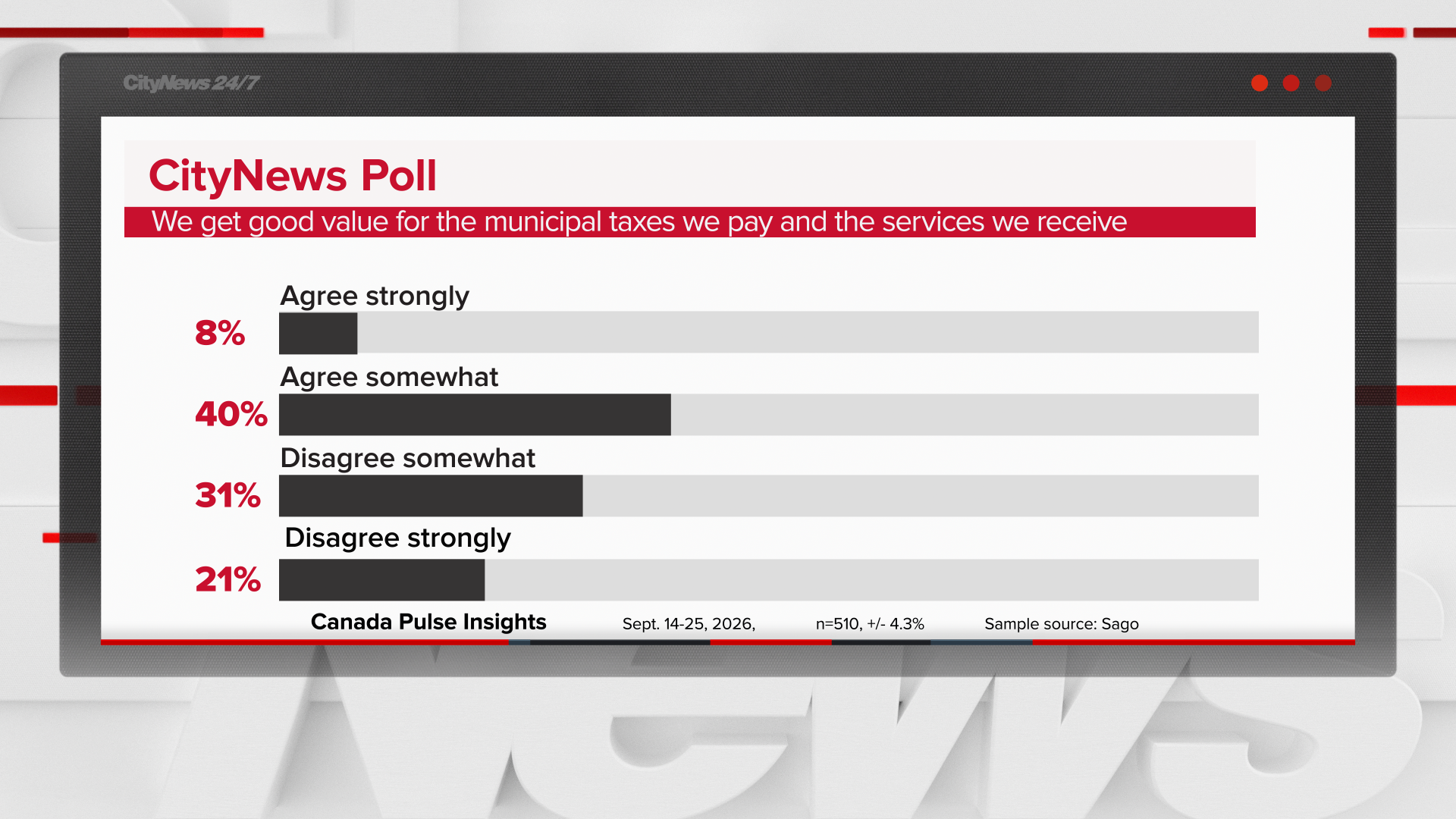
With the next municipal election less than a week away, a new poll has found Torontonians are divided on whether they get good value for the municipal taxes they pay and the services they receive.
Forty-eight per cent agree that they get good value, while 52 per cent disagree.

The survey completed by Canada Pulse Insights for CityNews found the same split when asking respondents whether they would support a residential tax increase to fund municipal services and infrastructure.

Four in 10 Torontonians opposed the increase and did not believe they get good value for their municipal taxes, while 36 per cent say they do get good value and would support paying more.
The poll also found that younger residents aged 18 to 34 were more likely to say they receive strong value for their municipal taxes, with 56 per cent agreeing compared to those 35 to 54 of age at 42 per cent.
Younger residents also said they would pay more with 53 per cent supporting a residential tax increase compared to 38 per cent of those aged 35 to 54.
Older adults also named taxes and spending as an election concern with 31 per cent of those aged 55 and over naming it as a top-three issue compared to just 12 per cent of those aged 18 to 34.
Taxes have been a prominent topic in the mayoral election with candidate Brad Bradford promising to freeze property taxes in his first year in office and repeatedly taking aim at incumbent Olivia Chow’s increases during her first two years in office, including a 9.5 per cent increase in 2024.
Chow has pledged to keep tax increases at or around the rate of inflation if she is re-elected.
Pollster John Wright said this survey clearly shows the divide between Chow voters and Bradford voters.
“Olivia Chow’s camp, who want to see more taxes, who believe that quality of life could be better, versus the Bradford camp who, in fact, don’t want to see [more] taxes [and] believe that the quality of life is not great in the city. So, this cuts down the middle, but mainly on age and income, and it’s playing out as we see in the final days of this campaign.”
He adds younger people are more inclined to support tax increases because they are also more likely to be renters and not immediately impacted by the increase.
In the GTA, including Peel Region, Durham Region, York Region and Halton Region, residents were split down the middle on whether they received good value for their municipal taxes, but 58 per cent opposed a residential tax increase.
Twenty-eight per cent of respondents also ranked it as a top-three issue facing their municipality in the GTA, behind affordability and the cost of living at 40 per cent and crime, policing and public safety at 30 per cent.
Wright said when it comes to taxes and quality of life in a city, the main thing it comes down to is the affordability of it.
“[Affordability] is, in every major centre across the country, the number one issue. And as a result of that, every new town council, every new city council that’s elected, every mayor that’s dealing with these issues has to deal with a push and pull of people who want more services, whether it be for police or structure or for roadways, which require more taxes and the ability to pay for them in pinched pocketbooks.”
This survey was conducted among a random sample of 510 adult residents of the City of Toronto and 825 GTA residents including Peel Region, Durham Region, York Region, and Halton Region Mississauga and the regional municipalities of Durham, York, Halton and Peel by Canada Pulse Insights between September 14 and 25, 2026 through an online panel platform managed by Sago. The margin of error for a probability-based sample of this size is ±4.3 percentage points for Toronto and ±3.4 for the GTA, 19 times out of 20.